The truth about your room, for the AI you already use.
A photo of a room is not a room. It carries no scale and no measurement you can trust. RoomRead scans the real space with your phone and gives ChatGPT the shape and the measurements of it — checked before it is used, accurate to about a centimetre.
Your AI isn’t stupid. It’s blind.
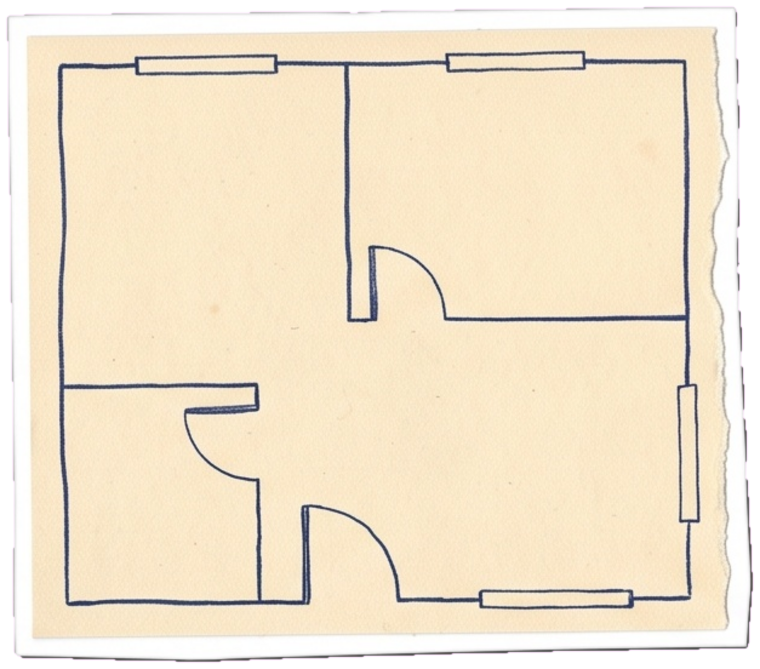
Why a photo is not a room
Ask ChatGPT to design a run of wardrobes for your bedroom and it answers from a description. What comes back is a picture of wardrobes: sensible proportions, no relation to the wall it has to fit.
A description carries no scale. Nothing in the phrase “a bedroom with a window” says how far the window is from the corner, or where the radiator sits. Without those numbers, a plan is a confident guess.
How it works
You scan the room
One walk around the space with your phone. The scan records the depth of what it sees and the camera’s path through the room.
We check it before it is used
Coverage, tracking, depth and duplication, read from the scan’s own report. A scan that fails the check does not get passed on.
It gets the room, not a description
The shape and the measurements of the space, so what comes back fits the room you actually have.
What comes back
A plan you can build from, and a cutting list you can take to the saw. That is the point of the measurements. A millimetre of drift in a description gives you a picture that looks wrong; a centimetre of drift in a cut costs you a sheet of ply.
The app
The scanning is done by a phone app. You walk the room once, it checks the capture before anything is built on it, and the plan comes back in ChatGPT — on the subscription you already pay for.
Coming soon to the Apple App Store
Which devices can scan
Scanning needs a LiDAR sensor — the small dark circle on the back of the camera bump that is neither a lens nor the flash. On iPhone, Apple has only ever put it in the Pro models. The iPhone 12 Pro was the first, in 2020:
- iPhone 12 Pro, 12 Pro Max
- iPhone 13 Pro, 13 Pro Max
- iPhone 14 Pro, 14 Pro Max
- iPhone 15 Pro, 15 Pro Max
- iPhone 16 Pro, 16 Pro Max
- iPhone 17 Pro, 17 Pro Max
The iPad Pro works as well — the 11-inch (2nd generation) and the 12.9-inch (4th generation) from 2020, and every iPad Pro since. The standard iPad, the iPad Air and the iPad mini do not have the sensor.
No sensor, no scan. The iPhone Air, the 16e and 17e, and every standard, Plus, mini and SE iPhone go without it — and a camera on its own cannot measure a room accurately enough to cut to. If you don’t have a Pro to hand, borrow one for the scan: the plan is a file, and it stays yours.
Measured, not assumed
The accuracy is a number, not an adjective. These are the figures from the scans we work with, measured against a tape rather than taken on trust.
Scan accuracy, measured
- Floor plane, RMS
- 14 mm
- Walls, RMS
- 8–14 mm
- 95th percentile
- 15–31 mm
- What we quote
- about a centimetre
What we don’t claim
- Not millimetre accuracy. Our scans measure to about a centimetre, and that is what we say.
- Anything cut to size still gets taped. Tolerances are quoted at ±1–2 cm, and you check the cut before it matters.
- Not a replacement for a joiner or a surveyor. Where a job needs one, it needs one.
- Not shipped. The scans are real and measured. The plan pack, the cutting list and the ChatGPT connection are what we are building next.